

Mobile Laminar Airflow Trolley
Fabtech supplies mobile LAF trolleys that keep a sterile load under ISO Class 5 air while it moves. Sterile material often has to move from one room to another.
A mobile LAF trolley is a cart that runs on a battery and carries the material under its own supply of clean, filtered air. The load crosses a corridor and a lower-grade area and arrives still sterile. The clean air zone moves with it and does not end at the door.
Our GMP and FDA-compliant, battery-operated trolleys provide product protection and sterile transport through cleanrooms of lower classification.
We reply within 24 hours.
The trolley protects the product with targeted airflow. Clean air with low turbulence flows vertically or horizontally onto the work area of the transfer cart.
The air then goes out into the surrounding area. The motor blower is statically and dynamically balanced.
This gives it enough capacity and static pressure to keep the required airflow for the entire lifetime of the HEPA (high-efficiency particulate air) filter.
The trolley collects airborne particles and discharges them in a controlled way. An electronic system monitors the safety functions.
HEPA filters capture particulates. They do not capture gases or vapours.
On this page
Key fact Detail
- Power
- Battery operated
- Air cleanliness
- ISO Class 5
- Air velocity
- 0.45 ± 0.05 m/s, vertical airflow
- Filter
- H14 or H13 HEPA
- Construction
- Powder-coated SS 304 or SS 316
LAF and RLAF are opposite machines
This is the question buyers ask most often about laminar airflow.
Choosing the wrong machine is an expensive mistake.
LAF, laminar air flow, protects the product. Filtered air moves in one direction over the work zone.
It then flows out into the room and toward the operator. Anything in the air of the work zone is carried away from the product and toward the person.
RLAF, reverse laminar air flow, protects the operator. The unit pulls air away from the person and into the filters.
A dispensing booth uses RLAF when the material is dusty and the person needs protection.
To choose, ask what is at risk. If the product is at risk, you need laminar flow, and this trolley is a mobile version of it.
If the operator is at risk, you need reverse flow, which is a sampling and dispensing booth.
If both are at risk, you need equipment built to protect both at the same time. That is a sampling and dispensing booth for material of lower hazard, and a containment isolator at negative pressure for material of higher hazard.
The industry grades this hazard in occupational exposure bands, written OEB. The scale shows how hazardous a material is to the people who handle it.
The band of your material decides which of the two you need.
A mobile LAF trolley gives the operator no protection at all. It is designed this way, and this is not a fault.
Why the trolley runs on a battery
A trolley that runs on a mains power cable cannot move freely while it works.
With a battery, the airflow never stops. It keeps running when the trolley is unplugged, when it crosses the corridor and when it waits at an airlock.
An airlock is the small room between two areas of different cleanliness. The clean zone stays unbroken from the start of the route to the end.
The load arrives under the same clean air it started under.
So the figure to specify is run time, not motor size. Run time is how long the trolley must hold ISO Class 5 between charges.
ISO Class 5 is a grade of air cleanliness. Work out the run time on the longest route you use.
Include the longest possible waiting time at the airlock.
What the trolley carries
In the pharmaceutical industry a mobile LAF is used to move sterile loads.
Examples are sterilised components going from the autoclave (steam steriliser) to a filling line, filled product going between suites, media plates, and sterile assemblies that cannot be wrapped again.
The shelves are removable and perforated, which means they are full of small holes. The holes matter because a solid shelf blocks the downward airflow.
The area under a solid shelf then gets no clean airflow. The shelves are removable because the shape of the load changes with each product.
Potent material must not travel on this trolley. Potent means a drug that acts at very small doses.
The trolley pushes air off the load and into the room. If the load releases something hazardous, the trolley blows it into the room too.
Holding ISO Class 5 while the trolley moves
The trolley has the same performance figures as a fixed LAF unit: ISO Class 5 air at 0.45 ± 0.05 m/s vertical airflow.
The engineering task is to hold these figures while the trolley moves.
Two features do this. The automatic fan control keeps the LAF speed constant as the filter collects particles with use.
So the air speed does not fall over the filter's life. The digital gauges show the pressure drop across the filter, which tells you when the filter is used up.
The perforated plate or membrane distributor sits at the outlet surface. It spreads the blower's air evenly over the whole outlet, so the air does not leave as a single jet.
Laminar flow needs this even spread.
Noise is below 67 dB on Scale A when the background (ambient) noise is no greater than 55 dB. This matters because a trolley works next to people for hours.
Vibration and noise are the reasons operators switch off a trolley that was specified too low.
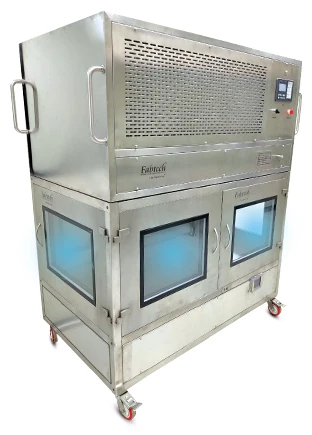
Specifications
Material of construction: powder-coated SS 304 / SS 316
HEPA filter H14 / H13
Digital gauges and automatic fan control for constant LAF speed
Perforated plate or membrane distributor air outlet surface
Removable perforated shelves
Battery operated
Performance: air cleanliness ISO Class 5; air velocity 0.45 ± 0.05 m/s, vertical airflow
Minimum vibration; noise below 67 dB on Scale A when ambient is no greater than 55 dB on Scale A
Electronically monitored safety functionality
What a mobile LAF trolley costs
We do not publish a price. The price depends on these things, and they vary by an order of magnitude between orders:
- the work area you need covered
- the run time between charges
- the stainless steel grade
- the filter class
- the shelf configuration
- the electrical and documentation requirements of the destination market
Run time and work area have the biggest effect on the price. SS 316 costs more than SS 304. Export documentation also adds a real cost line to the price. Send us these details and we will give you a single figure instead of a range.
We quote this trolley for export orders. For a cleanroom project at an Indian site, please contact Fabtech Technologies Cleanrooms, for projects in India, which is a separate company and is listed separately.
Other units in the clean-air range
The trolley is the mobile unit in a family that also includes fixed units and benches:
- Vertical LAF unitis a fixed unit for larger process areas, up to a filling line. It is also the page for LAF supply enquiries from Oman, Saudi Arabia and Kuwait.
- LAF workbenchis the bench-scale LAF work station for laboratory work.
- Dynamic pass boxis for material that passes from one area to another without a person carrying it.
FAQ
What is a mobile laminar airflow trolley?
It is a portable, self-contained workstation that runs on a battery. It creates a local ISO Class 5 zone over its load. Sterile material stays protected while it moves through areas of lower classification.
What is the difference between LAF and RLAF?
The direction of the air, and so the purpose. LAF pushes filtered air over the product and out toward the operator. It protects the product. RLAF pulls air away from the operator and into the filters. It protects the person. If both need protection, you need a containment isolator instead.
Why is LAF used?
LAF holds a defined clean zone at the point of work, whatever the grade of the room. This is cheaper and faster than bringing the whole room up to that standard.
Which filter is used in an LAF?
A HEPA filter, grade H14 or H13. H14 captures particles at a higher efficiency. The choice depends on the grade you must hold and the qualification you must pass. HEPA filters capture particulates. They do not capture gases or vapours.
Does the trolley protect the operator?
No, it protects the product. Air moves from the filter, across the load, and out toward the person pushing the trolley. Never use one for potent or hazardous material.
How long does the battery last?
We specify the run time for your route. Run time between charges is one of the two figures that sizes the trolley. The other is work area. Tell us the longest journey the trolley must make, including waiting time at airlocks.
What are the key features?
The trolley is mobile and has HEPA filtration to H14/H13. Automatic fan control keeps the air speed constant as the filter collects particles. It also has removable perforated shelves, low-noise operation and electronic safety monitoring.
Can it be customised?
Yes. You can specify the work area size, airflow direction, filter grade and shelf configuration, and ask for other adaptations.
Can it be used in both sterile and non-sterile environments?
Yes, depending on the design. It must not be used for potent material in either environment.
Is training required?
Basic training is recommended, mainly on where to place the load. A tall item on a shelf blocks the airflow to everything behind it. This is the most common reason a correctly specified trolley stops working as intended.
How is it qualified?
Through the standard qualification sequence. It maps airflow velocity, counts particles to ISO 14644 and tests the filter by DOP or PAO, which are test aerosols. The tests are done with the trolley standing still and again on its working route.
Tell us what you are moving, the route it takes and the run time you need between charges. We will size the trolley
We reply within 24 hours.