Fabtech supplies the Liquid Dispensing Isolator with laminar airflow at ISO 5 Grade A and inline sterile filters. Dispensing pre-sterile liquids demands a sterile environment, so that the product is not contaminated by the bio-burden around it.
Bio-burden means the live microbes in the surroundings. This is an aseptic unit. It protects the liquid from the room and from the operator.
Fabtech's safe transfer mechanisms can safely transfer products into the Liquid Dispensing Isolator. There they are measured and dispensed into smaller containers, using inline sterile filters for a sterile transfer.
The system is compatible with VHP decontamination to achieve an aseptic environment and process integrity. VHP means vaporised hydrogen peroxide.
Ask for the chamber pressure, the leak test and the qualification documents in your enquiry.
On this page
Key fact Detail
Sterile transfer
Inline sterile filters
Monitoring
Online particle counter integration
What it does
Measures and dispenses liquid into smaller containers
Chamber
SS 316L, with laminar airflow at ISO 5 Grade A
Liquid or powder: which unit you need
Dispensing can mean two different jobs, and each needs its own unit.
A sterile liquid
A liquid that must stay sterile needs this unit. The danger is to the product.
One microbe from the room can spoil a whole container. So the air inside is kept cleaner than the room, and the liquid passes a sterile filter on its way to the container.
A potent powder
A potent powder that must not reach people needs a different unit. The danger is to the operator.
Dispensing isolators for powder run at negative pressure and are built for weighing. If that is your job, see the sampling and dispensing isolator.
First, the chamber is prepared. Where H2O2 decontamination is fitted, the chamber is decontaminated with VHP before dispensing and between products.
The product comes in through a safe transfer. Tell us how your bulk liquid arrives.
Inside, the liquid is measured. The work is done under laminar airflow at ISO 5 Grade A.
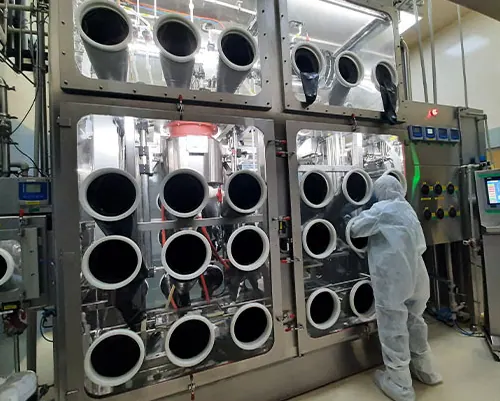
Laminar airflow is clean air that moves in one direction, so it carries particles away from the open liquid. The operator works through glove ports, which are sealed gloves fixed in the chamber wall.
The liquid passes an inline sterile filter. Inline means the filter sits in the line that carries the liquid.
A sterile filter is fine enough to hold back microbes.
The filtered liquid is dispensed into smaller containers. Each one is filled inside the clean air of the chamber.
Specifications
Robustly constructed in SS 316L with laminar airflow, ISO 5 Grade A classification
Customisable ergonomics
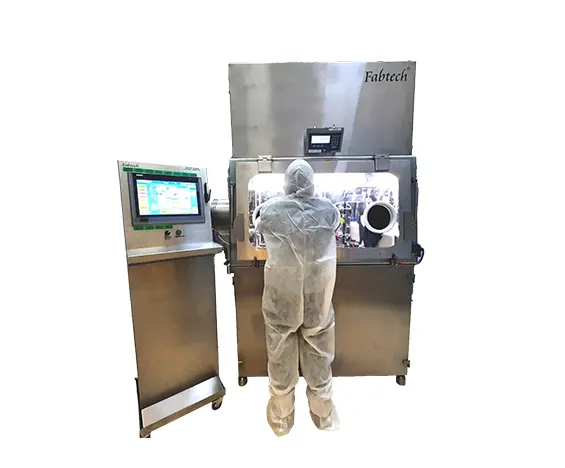
Standard configuration: one pass box with 2 glove ports, main chamber with 4 glove ports, and a glove integrity tester
Multiple chamber configuration options available
On-demand process equipment (fitted when you ask for it) and online particle counter integration
H2O2 decontamination optional
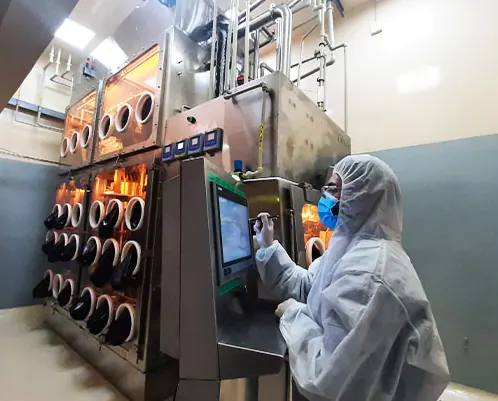
Password protection for different authorisation levels
Pass box, 2 glove ports
Main chamber, 4 glove ports
This isolator
Filling isolator line
Mobile isolator
Sterility testing isolator
Radiation shielding
Where it fits in a sterile plant
This isolator measures a liquid into smaller containers.
It is one of the aseptic isolators in our range, and each of them does a different job. A production line that fills thousands of vials or syringes is a different machine.
The unit can be customised according to batch sizes, process volumes, existing machines or process automation needs.
So we ask for these:
The liquid. Tell us what it is and whether anything in it is hazardous to people.
The volumes. The size of the bulk container, and the size and number of the small containers.
The filter. The sterile filter you use today, if you have one.
Existing machines. Any pump, balance or filling device that must go inside.
Monitoring. Whether you want an online particle counter built in.
The unit, with its control screen on a stand
Working through the glove ports
At the control screen
FAQ
What industries use liquid dispensing isolators?
Liquid dispensing isolators are used in the pharmaceutical, biotechnology, hospital and diagnostic industries. Fabtech's own work is in pharmaceuticals, biopharma and healthcare only.
What are the advantages of using a liquid dispensing isolator over traditional cleanroom dispensing?
A liquid dispensing isolator provides higher operator safety and reduces the risk of product contamination, compared with traditional cleanroom dispensing. The operator works from outside the chamber, through glove ports.
Can a liquid dispensing isolator be customised for specific processes?
Yes. It can be customised according to batch sizes, process volumes, existing machines or process automation needs.
What material is used for constructing a liquid dispensing isolator?
Stainless steel, toughened glass and non-reactive polymers are typically used. Fabtech's unit is constructed in SS 316L, a grade of stainless steel.
How many glove ports are standard in a liquid dispensing isolator?
The standard configuration has a main chamber with 4 glove ports and a pass box with 2 glove ports. It can be customised according to your needs.
Is inline sterile filtration available for liquid dispensing isolators?
Yes. Fabtech supplies the Liquid Dispensing Isolator with laminar airflow at ISO 5 Grade A and inline sterile filters. Inline sterile filtration units can be integrated for aseptic liquid dispensing.
Can the isolator integrate with online particle counters?
Yes. Continuous particle monitoring systems can be connected with isolators.
How does password protection for authorisation levels work in the system?
Password protection gives different authorisation levels. This prevents unauthorised changes to process parameters or audit trails. An audit trail is the record of who did what, and when.
Is a liquid dispensing isolator the same as a sampling and dispensing isolator?
No. This unit protects a sterile liquid from the room. A sampling and dispensing isolator protects the operator from a potent powder. The two do opposite jobs.