

Filling Isolator (Vial / PFS / Cartridge)
Fabtech supplies vial filling isolators, and isolators for prefilled syringe (PFS) and cartridge lines. We supply vial and ampoule filling lines and PFS lines too. An isolator is a sealed, clean chamber.
Operators work inside the isolator through glove ports.
We reply within 24 hours.
Putting a filling line inside an isolator is harder than enclosing anything else in a plant. The reason is not sterility.
The filling line has moving parts, and it changes between container formats. Stoppers and caps must keep coming in while the line runs.
The isolator must stay sealed through all of this, at line speed. It must not be the reason the line slows down.
Parenteral drugs are medicines given by injection. Parenteral drug filling needs a bio-burden-free aseptic environment, with no live microbes.
This protects product sterility, integrity and safety. Fabtech's aseptic filling isolators enclose the line for batch production of vials, prefilled syringes and cartridges.
Inside the working chamber, the air moves in one direction (unidirectional airflow). The chamber is held at ISO 5 Grade A, a cleanroom air class that allows very few particles.
Dedicated air handling units run 80-20 or 90-10 circulation.
On this page
Key fact Detail
- Filling lines Fabtech supplies
- Vial, ampoule and PFS lines
- Air in the working chamber
- ISO 5 Grade A, unidirectional airflow
- Air circulation
- 80-20 or 90-10
- Glove ports in the standard configuration
- 4 on the main chamber, 2 on the pass box
- Decontamination
- Integrated H2O2 unit
Designed around your filling line
Fabtech designs the filling isolator to fit around your filling machine and to match the speed of your line.
A filling isolator is different from a testing or dispensing isolator in three ways. It is also one part of a sterile plant. The rooms around it are covered under sterile facility design and construction.
It must match the line speed.
The isolator is built around a production machine. So its airflow, transfer rate and access must keep up with the speed of the line.
They are not set to an operator's pace. If the isolator makes the line slow down, it has failed, even if its particle counts are good.
Components must keep coming in.
Stoppers, plungers, bungs and caps must enter all the time, without opening the isolator to the room. Fabtech uses FabLife's proprietary transfer mechanisms for rubber bungs and aluminium caps.
Pre-sterilised components enter through rapid transfer ports. A rapid transfer port is a sealed double door.
It lets items pass in without letting room air in.
It must change between formats.
Vials, prefilled syringes and cartridges each need different handling, different change parts and a different presentation. The chamber must allow a format changeover without a full requalification each time.
This means the full set of tests is not repeated after every change.
Specifications
These are the main features of Fabtech's filling isolator.
- Robustly constructed in SS 316L with laminar airflow, ISO 5 Grade A classification
- Dedicated air handling units with 80-20 or 90-10 air circulation
- Customisable ergonomics
- Standard configuration: one pass box with 2 glove ports, main chamber with 4 glove ports, and a glove integrity tester
- Multiple chamber configuration options available
- On-demand process equipment and online particle counter integration
- LAF-covered openings to ensure robust sterility
- Rapid Transfer Port for safe transfers
- Integration with the filling line at various speeds
- Simplified transfer of rubber bungs and aluminium caps using FabLife's proprietary transfer mechanisms
- H2O2 decontamination unit integrated with the isolator and the process
- Password protection for different authorisation levels
- Optional IPC SCADA 21 CFR Part 11 for high-grade integration and compliance
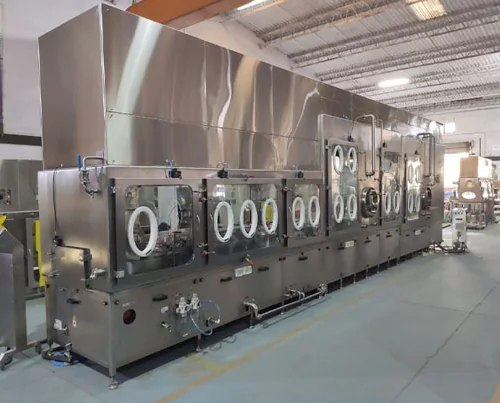
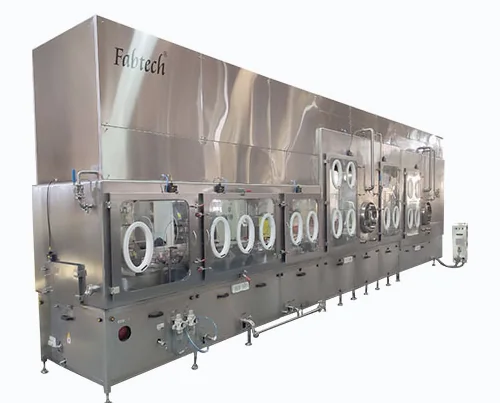
Airflow and how ISO 5 Grade A is held
Air enters the chamber through H14 filters.
H14 is a high grade of HEPA filter. The air then moves across the chamber in one direction.
This carries particles away from the open container, so they do not settle into it.
The 80-20 and 90-10 options show how much air is recirculated and how much is fresh air. The right choice depends on the product, the amount of solvent in the air, and how much heat the line inside gives off.
The openings are LAF covered. LAF means laminar airflow, clean air that moves in one direction.
So the protected zone covers every point where a container is open. Particle counters can be built in.
They monitor the air all the time, instead of by sampling now and then.
Formats: vial, prefilled syringe, cartridge
Each type of container is handled in its own way inside the isolator.
| Format | What the isolator has to handle |
|---|---|
| Vial | Stopper and cap feed. Crimping (sealing the aluminium cap) inside the isolator or just after it. Larger transfer volumes |
| Prefilled syringe (PFS) | Nested tubs. Plunger placement. Gentler handling. Tub debagging (removing the outer bag) inside the isolator |
| Cartridge | Nested like PFS, but the closures are handled differently. Common for pen devices |
If a line runs more than one of these formats, size its transfer system for the largest tub or tray it will ever use. Measuring a pre-sterile liquid into smaller containers is a separate job, done in a liquid dispensing isolator.
Cleaning, decontamination and validation
The chamber is cleaned with disinfectant after each batch.
A campaign is a series of batches of one product. Between campaigns, the chamber is bio-decontaminated with VHP (vaporised hydrogen peroxide).
The VHP generator is built into the isolator. It is not a separate unit that is wheeled in.
The filters are validated by DOP or PAO integrity testing. This test checks the filter for leaks.
Filters are changed by GMP protocols. The filter housings let a filter be changed without exposing the operator to what it has collected.
Qualification follows the normal DQ/IQ/OQ/PQ route. On an aseptic filling isolator, the performance stage includes media fills on the line inside it.
A media fill is a trial run that uses a growth medium instead of the drug. Control systems that hold electronic records are built to 21 CFR Part 11, the US FDA rule for electronic records.
FAQ
What industries typically use vial filling isolators?
Mainly pharmaceuticals and biologics. Research and development teams use them too. Any plant that fills a sterile injectable medicine into a container is a candidate for one.
How does Fabtech's isolator integrate with existing filling lines?
Fabtech's isolators are modular and custom-designed to fit around existing filling machines. You do not have to replace an installed line to enclose it.
Is the filling isolator suitable for high-speed production lines?
Yes. Fabtech sets up the isolator to match the throughput of the line. The line does not have to adapt to the isolator. So please include your line speed and format mix in your enquiry.
Can the isolator be integrated with online particle counters?
Yes. Online viable and non-viable particle counters can be integrated. Viable counters detect live microbes. Non-viable counters count all particles. They give continuous environmental monitoring and help with regulatory compliance.
What safety features protect the operator?
Glove ports, filtration and alarm systems. A pressure differential also stops contamination from escaping toward the operator.
What is the airflow pattern inside the filling isolator, and how is ISO 5 Grade A maintained?
The air moves in one direction (unidirectional airflow). It passes through H14 filters and covers the whole working chamber. This keeps Grade A conditions at the points where containers are open.
How is the HEPA filtration system validated and maintained?
The filters are validated by DOP or PAO integrity testing. Filters are changed by GMP protocols. The filter housings make the change safe.
What protocols are followed for cleaning and maintenance?
The chamber is cleaned with disinfectant after each batch. It is bio-decontaminated with VHP between campaigns. Gloves, seals and pressure differentials get routine checks in between.
Does Fabtech supply the filling line as well as the isolator?
Yes. Fabtech supplies vial and ampoule filling lines and prefilled syringe (PFS) lines, and the isolators that enclose them. Please tell us in your enquiry whether you need the line, the isolator or both.
Can one isolator handle vials, syringes and cartridges?
Yes, if the change parts and transfer sizes are planned from the start. Adding a second format later to a chamber built for one format costs more.
Is this the same as a sterility testing isolator?
No. This isolator encloses a production filling line. A sterility testing isolator is a QC laboratory unit. It tests samples after the batch is filled.
Send us your line, your formats and your speeds. We will plan the isolator to fit your line
We reply within 24 hours.