

Granulation Isolator
Fabtech supplies a granulation isolator that holds the sifter, RMG, FBD, mill and blender in one isolator, from 200 g to 15 kg. Granulation turns fine powder into small grains that flow evenly and press well into tablets.
The blend batch can be up to 30 kg. This is a containment unit. Its chamber runs at negative pressure, to protect the operator and the environment from a potent powder.
We reply within 24 hours.
Fabtech offers containment solutions for wet and dry granulation. Buyers usually ask for them for processes involving potent OEB 4 or OEB 5 products.
OEB is the exposure band of the product. Your own occupational hygienist sets the band for your product.
The process within the isolator must be optimal to safeguard the operator and the environment.
The ergonomically built negative pressure chamber safely contains the products during processing, with glove ports for easy access. Glove ports are sealed gloves fixed in the chamber wall.
Material is transferred safely in and out of the isolator through the pass box or antechamber, a small sealed entry chamber.
Ask for the chamber pressure, the leak test and the qualification documents in your enquiry.
On this page
Key fact Detail
- Equipment in one isolator
- Sifter, RMG, FBD, mill and blender
- Capacity
- 200 g to 15 kg
- Blend batch
- Up to 30 kg
- Enclosed dispensing
- Split Butterfly Valve, into IBC bins or polybags
- Transfer route
- RTP (rapid transfer port)
- Drum loading
- PLC-operated drum loader
Five machines in one isolator
On an open granulation line, the powder is carried from one machine to the next, and each move can release dust.
In this unit, the granulation equipment, including the sifter, RMG, FBD, mill and blender, is all contained in one isolator.
The powder stays inside the chamber from the first machine to the last. The operator reaches the equipment through the glove ports.
The isolator is integrated with the processing equipment for optimal performance and safety.
The capacities start at 200 g. Tell us if you need a contained granulation solution for R&D or for production, and we plan the machines and the chamber for your batch.
The granulation steps inside one isolator
The sifter comes first. It passes the dry powders through a screen.
This breaks up lumps and holds back any oversized particles before mixing starts.
The RMG (rapid mixer granulator) mixes the powders and then wets them with a binder liquid. Fast blades turn the wet mass into granules.
A granule is a small grain made of many powder particles stuck together.
The FBD (fluid bed dryer) dries the wet granules. Warm air rises through them and lifts them, so every granule dries at the same rate.
An isolator around this dryer is sometimes called a fluid bed isolator.
The mill brings the dried granules to one even size. Granules that are too large are cut down.
The blender mixes the granulate with the last ingredients, such as the lubricant that stops tablets from sticking. The result is the final blend.
The blend batch can be up to 30 kg.
Discharge is the last step, and the blend must leave without opening the chamber. Fabtech's Split Butterfly Valve dispenses the blend into IBC bins or polybags.
The valve has two halves, one on the isolator and one on the container. Both halves stay closed until they are joined.
An IBC is an intermediate bulk container, a bin on wheels.
These six steps are wet granulation. Dry granulation uses no liquid, so it has no wetting or drying step. The isolator can be used for both. Tell us your dry granulation machine.
Specifications
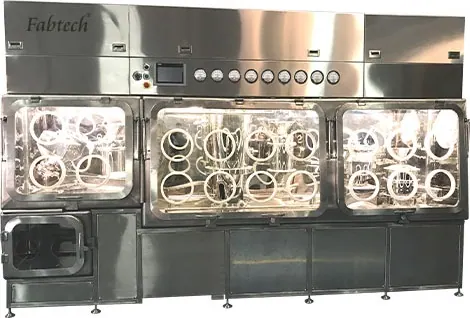
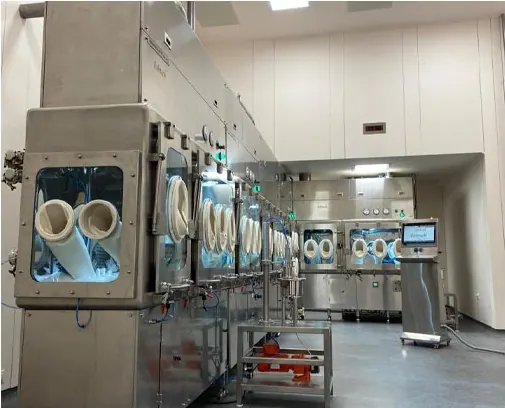
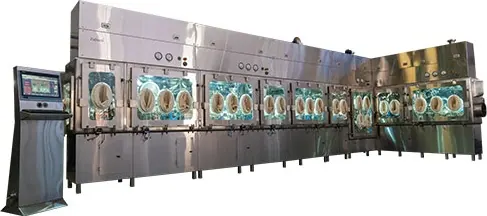
- Robustly constructed in SS 316L, with H14 HEPA filtration on inlet air and double HEPA filtration on exhaust
- Optional room air intake and dedicated air handling unit for temperature and humidity management
- Safe changing of HEPA filters
- Inline exhaust scrubber for exhaust air treatment
- Customisable ergonomics
- Standard configuration: one pass box with 2 glove ports, main chamber with 4 glove ports, and a glove integrity tester
- Multiple chamber configuration options available
- Enclosed dispensing into blender bins or product containers
- Transfer routes through RTP
- In-situ chamber washing and drying, with drain collection cachepot (a collection pot) for safe handling
- Waste liner port, a port lined with a bag, for waste bag discharge
- Password protection for different authorisation levels
- PLC-operated drum loader
- Optional IPC SCADA 21 CFR (control and data software on an industrial computer) for high-grade integration and compliance
Granulation isolator or a closed granulation line
There are two ways to keep a potent granulate away from people.
The first is this isolator: small machines inside one sealed chamber. The second is a closed loop granulation line, where full-size machines are joined by closed transfer pipes.
The isolator comes in capacities from 200 g to 15 kg, with a blend batch to 30 kg. A closed line is for larger batches.
A step that fits neither is planned as a custom negative pressure system.
The machines inside do the same jobs as full-size process equipment. The RMG is a high shear mixer granulator.
The FBD belongs to the same family as the fluid bed processor. Both pages explain the machine.
The isolator does containment granulation: keeping the powder inside while those jobs are done.
Granulation is the middle of the tablet process, and the steps on each side have their own units. Before it, the raw material is weighed in a sampling and dispensing isolator.
After it, the blend goes to a press inside a tablet compression isolator, or to a capsule filling isolator. Our guide to the OSD manufacturing process shows the whole line.
The pharmaceutical isolators page shows the whole range, with the other formulation isolators.
FAQ
How does granulation isolator technology ensure operator safety with OEB 4 and OEB 5 products?
A granulation isolator reduces operator exposure in the granulation process in the pharmaceutical industry through full physical containment, negative pressure, HEPA or ULPA filtration, validated transfer systems and alarms. Your own occupational hygienist sets the band for your product.
What granulation equipment can be integrated inside a single isolator?
In a single isolator, high-shear granulators and fluid-bed granulators are used along with equipment for milling, blenders and sieves. In Fabtech's unit, the sifter, RMG, FBD, mill and blender are all contained in one isolator.
How is negative pressure maintained during the granulation process?
Negative pressure is maintained during the granulation process in tablet manufacturing in three ways. A continuous extraction fan draws air out. The exhaust passes through HEPA or ULPA filters. Dampers control the airflow, and alarms report any deviation.
How does the RTP (Rapid Transfer Port) system work in a granulation isolator?
The Rapid Transfer Port (RTP) is a double-door system. It has two parts: the alpha flange, fixed to the glovebox wall, and the beta assembly, which attaches to a container, bag or equipment. When connected, they let materials move in or out without breaking containment, keeping operators safe from hazardous substances.
Can the granulation isolator be used for both wet and dry granulation processes?
Yes. Isolators can be used for both wet and dry granulation processes.
How is material transferred safely in and out of the granulation isolator?
Material is transferred safely with the help of bag-in bag-out systems, Rapid Transfer Ports (RTPs), Split Butterfly Valves (SBVs) or vacuum transfer.
Can the granulation isolator be customised to fit specific batch sizes?
Yes. Fabtech can customise it to fit specific batch sizes.
Is the granulation isolator compliant with cGMP and 21 CFR Part 11 guidelines?
Yes. Fabtech engineers it to cGMP and 21 CFR Part 11 guidelines. cGMP means current good manufacturing practice. 21 CFR Part 11 is the US FDA rule for electronic records.
What batch sizes does the granulation isolator cover?
Fabtech supplies a granulation isolator that holds the sifter, RMG, FBD, mill and blender in one isolator, from 200 g to 15 kg. The blend batch can be up to 30 kg.
Is a granulation isolator the same as a tablet compression isolator?
No. This unit holds the machines that make the blend. A tablet compression isolator holds the tablet press that turns the blend into tablets. They are two units in our range, and a potent product usually needs both.
Send us your product, its OEB band, your batch size and whether you granulate wet or dry. We will plan the isolator
We reply within 24 hours.